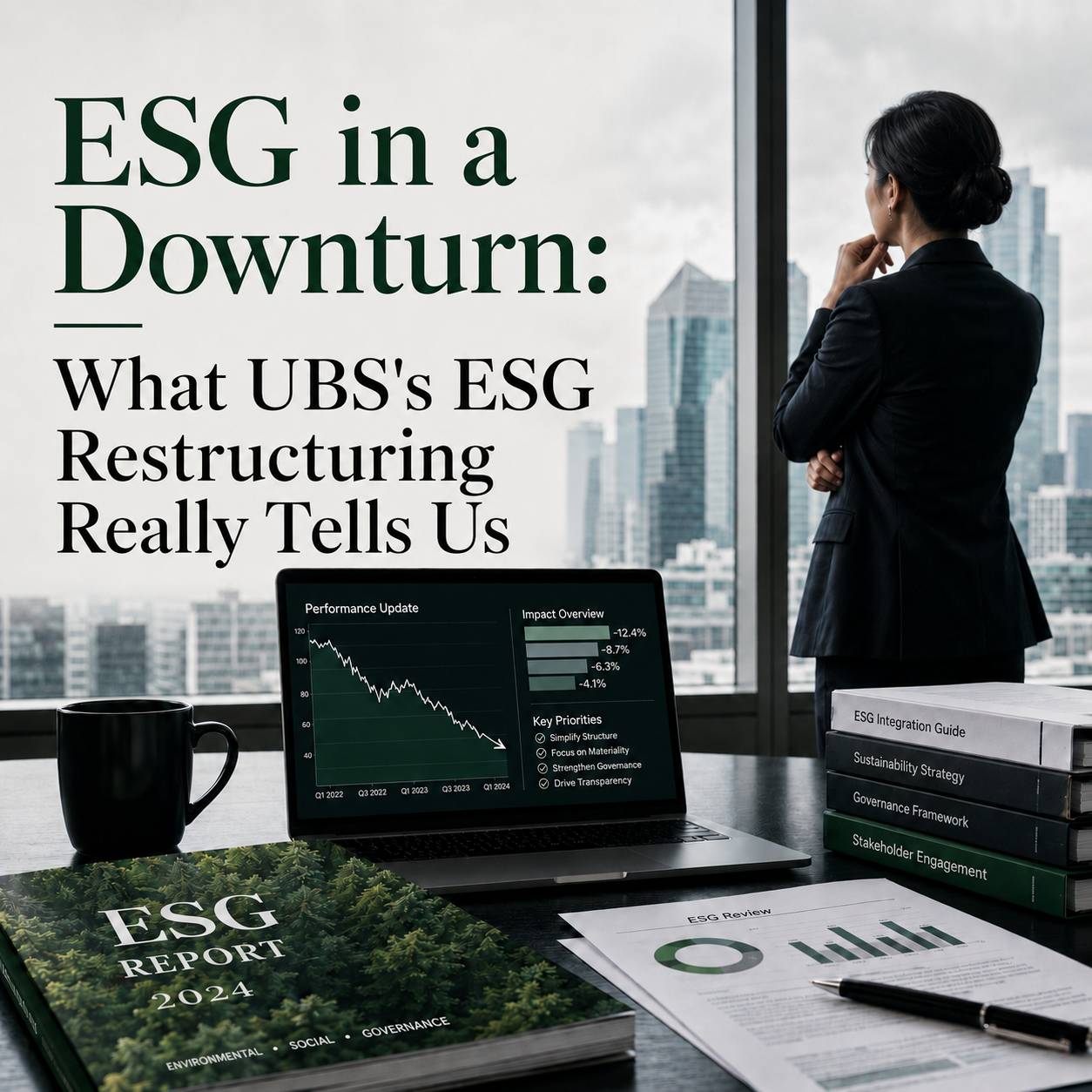
ESG in a Downturn: What UBS’s ESG Restructuring Really Tells Us
UBS ESG Restructuring Sparks Debate About the Future of ESG
Recent reports that UBS has significantly reduced the size of its Sustainability Office in Asia have reignited a familiar debate: Is ESG losing relevance?
According to media reports, UBS has reduced its Asia sustainability team from seven employees to three as part of a broader restructuring effort following the integration of Credit Suisse. Globally, the bank’s sustainability-related headcount is also reported to have fallen from more than 100 employees in mid-2023 to approximately 35 today.
To some observers, the conclusion appears straightforward. If one of the world’s largest financial institutions is reducing ESG-related roles, perhaps ESG itself is losing importance.
However, such a conclusion may overlook a more important development taking place across global businesses.
The real question is not whether ESG is disappearing. The real question is whether ESG is evolving.
Why ESG Teams Are Facing Greater Business Scrutiny
Economic uncertainty has forced organisations across industries to re-examine costs, streamline operations, and focus resources on activities that generate measurable value. In such an environment, functions perceived as administrative or non-core often come under scrutiny.
ESG teams are not immune to this pressure.
For years, many organisations have established dedicated sustainability departments responsible for reporting, stakeholder engagement, policy development, ratings management, and regulatory compliance. While these functions remain important, business leaders are increasingly asking a more fundamental question:
What value is ESG creating for the organisation?
This is particularly relevant at a time when companies face rising compliance obligations, slower economic growth, geopolitical uncertainty, and increasing pressure to improve profitability.
ESG Integration Is Replacing Standalone Sustainability Functions
Interestingly, UBS has not indicated that it is moving away from sustainability. Instead, the bank has stated that it is embedding sustainability responsibilities across the organisation to improve execution, eliminate duplication, and better support clients and business units.
This distinction matters.
The reduction of a standalone ESG function does not necessarily mean a reduction in sustainability efforts. In many cases, it may indicate that ESG responsibilities are becoming integrated into risk management, finance, operations, procurement, human resources, and strategic planning.
In other words, ESG is shifting from being a specialised function to becoming part of everyday business management.
ESG Trends Across Hong Kong, Singapore and Asia-Pacific
This trend is not unique to Europe.
Across Hong Kong, Singapore, Mainland China, and the broader Asia-Pacific region, companies are undergoing a similar transformation.
A few years ago, ESG initiatives were often driven primarily by disclosure requirements, investor expectations, or customer requests. Today, many organisations are looking beyond compliance and asking how sustainability can contribute to business resilience and long-term competitiveness.
Instead of focusing solely on producing sustainability reports, management teams are increasingly interested in understanding how ESG can help reduce operational costs, improve energy efficiency, strengthen supply chain resilience, access sustainable financing, attract customers, and manage emerging climate-related risks.
Moving Beyond ESG Compliance to Business Value Creation
This shift represents a natural maturation of ESG.
The era of treating sustainability as a standalone reporting exercise is gradually giving way to a more strategic approach that links ESG performance to business outcomes.
For sustainability professionals, this transition presents both a challenge and an opportunity.
The challenge is clear. ESG can no longer rely solely on regulatory requirements or stakeholder expectations to justify investment. Sustainability initiatives must increasingly demonstrate tangible business value.
The opportunity, however, is equally significant.
Organisations that successfully integrate ESG into decision-making processes may be better positioned to navigate regulatory changes, meet evolving customer requirements, strengthen investor confidence, and identify opportunities for innovation and operational improvement.
The Future of ESG and Sustainable Business Strategy
In this sense, the future of ESG may not be defined by the size of sustainability teams or the number of reports published each year. Instead, it will be defined by an organisation’s ability to embed sustainability considerations into the way it creates value.
At GreenCo, we believe that the future of ESG lies beyond compliance.
While regulatory reporting remains important, sustainable business practices should ultimately support stronger governance, better risk management, improved operational performance, and long-term value creation.
Periods of economic uncertainty often separate initiatives that are perceived as costs from those that are recognised as strategic investments.
The organisations that continue to invest thoughtfully in sustainability during challenging times are often the ones best positioned to emerge stronger when market conditions improve.
ESG Remains Critical for Long-Term Business Resilience
ESG is not immune to economic cycles. Yet the underlying drivers behind sustainability, resource efficiency, risk management, stakeholder trust, and long-term resilience, remain as relevant as ever.
The question for businesses today is no longer whether ESG matters.
The question is how ESG can create measurable value in an increasingly complex and competitive world.
|
ESG is not disappearing. It’s being forced to prove its value. The recent UBS ESG restructuring offers an interesting glimpse into where corporate sustainability may be heading next. |
About GreenCo ESG Consulting
GreenCo is a professional ESG advisory firm accredited with ISO 9001 in the Provision of ESG / Sustainability Reporting, Sustainanbility and Climate Disclosures and GHG Accounting Advisory Services. Established in 2016, we were born to tackle ESG and climate risk management challenges. GreenCo has a professional team consists of talents with multiple backgrounds with
- PhD
- Practitioner Member of the Institute of Sustainability and Environmental Professionals (ISEP)
- CFA (the CFA Institute) and Certificate in ESG Investing
- EFFAS Certified ESG Analyst (CESGA)
- GRI Certified Sustainability Professional
- Certified Public Accountant (for assurance in accordance with ISAE 3000)
- Member of Global Association of Risk Professionals
- Master’s degree in envirnomental science
GreenCo has solid track record in ESG advisory for over 80 listed companies in Hong Kong, Mainland China, Singapore and Korea, covering all industries under the Hang Seng Industry Classification System.