Do Carbon Credits Really Help Offset Emissions?
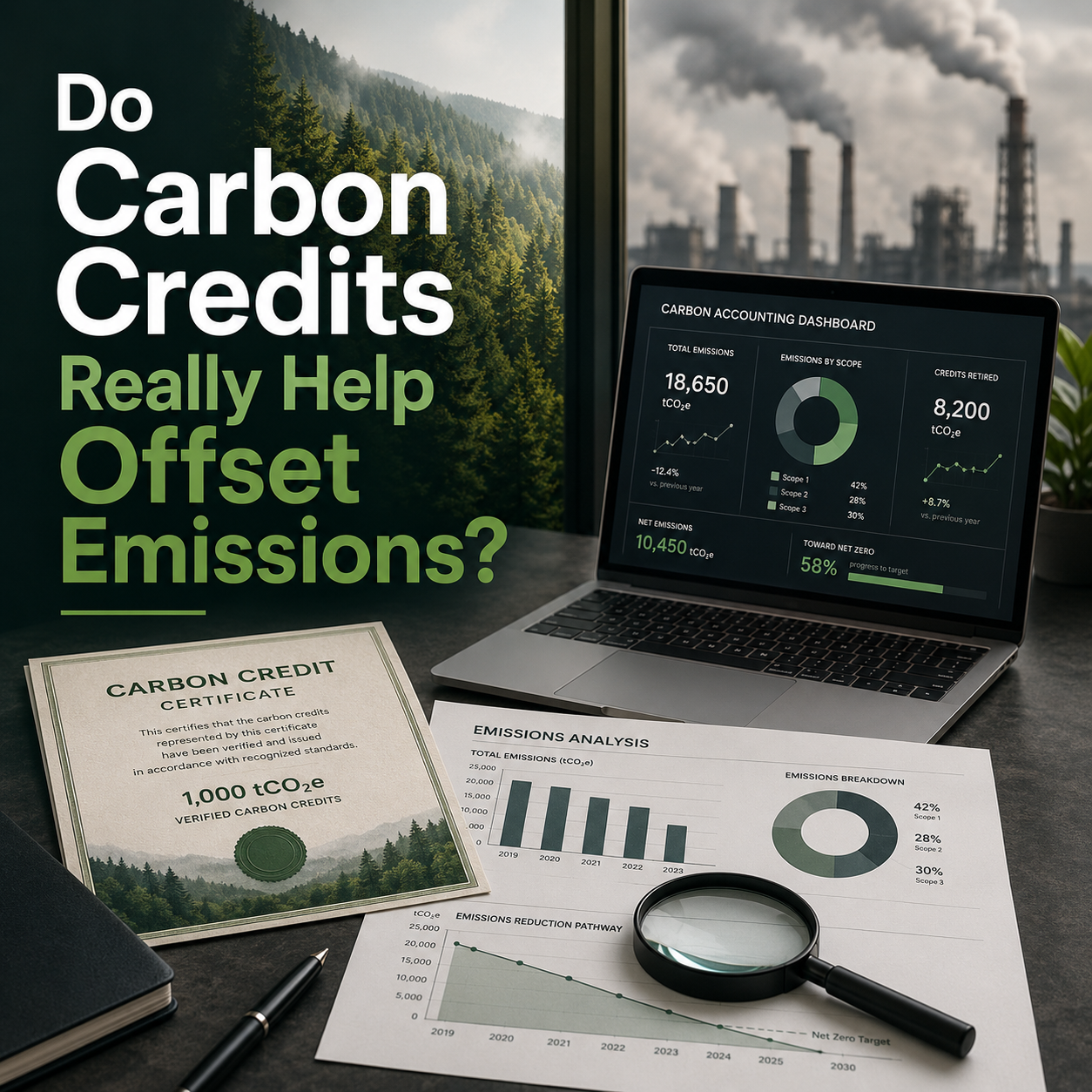
Under the intensifying pressures of climate change, achieving net zero greenhouse gas (GHG) emissions has become an urgent global priority. While directly cutting GHG emissions is the most effective way to mitigate global warming, purchasing carbon credits has emerged as a popular strategy in recent years. However, the credibility of carbon credits remains under scrutiny by international initiatives.
What is the Role of Carbon Credits in Offsetting?
In general, carbon offsets are achieved through emissions avoidance, emissions reduction, and carbon removal. To offset carbon emissions of operations, companies may purchase these three types of carbon credits, which represent the mitigation outcomes of projects that result in lower GHG emissions compared to a reference scenario.
Case Study: REDD+ Carbon Credits
Reducing Emissions from Deforestation and Forest Degradation (REDD+), a type of project providing carbon credits in the voluntary carbon market (VCM), utilises corporate capital, who paid to offset its carbon emissions generated, to preserve forests and avoid GHG emissions. Theoretically, these projects “balance” the residual emissions emitted by companies.
Nonetheless, it should be noted that the credibility of these credits relies on “additionality”, one of the Core Carbon Principles (CCPs)[1] that requires the mitigation activity shall be additional. In other words, the forest preservation would not have occurred in the absence of the incentive created by carbon credit revenues.
Meanwhile, the real-world effectiveness of REDD+ projects face challenges. Scientific studies[2],[3] have revealed that some claimed GHG emissions offsets do not represent real emission reductions. This discrepancy flags up the reliability of offset practices. Moreover, cross-border crediting (e.g., a company in Country A funding forest preservation in Country B) demands CCPs of robust quantification, rigorous third-party validation and verification, continuous tracking, as well as strict mechanism to avoid double-counting and ensure credibility.
Projects in forest preservation are also particularly vulnerable to the risk of reversal via wildfires, pest infestations, or illegal logging. This challenges another CCP of “permanence”, which indicates that the GHG emission reductions or removal from the mitigation activity shall be permanent, to weaken credibility.
Under the Science Based Targets initiative (SBTi) Framework
Historically, the SBTi excluded the use of carbon credits for emission reductions in meeting near-term or long-term science-based targets. Carbon credits can only be considered to neutralise residual emissions beyond the emission reduction targets.
With the launch of the SBTi Corporate Net-Zero Standard V2.0 in June 2026, a balanced approach with the integration of high-integrity carbon credits has been introduced. Through voluntary recognition programme, carbon credits serve as a complement to fund climate mitigation but not a substitute to cut carbon emissions under the framework of ongoing emissions responsibility.
GreenCo’s Tips: Ask These Questions when Selecting Carbon Credits
To avoid investing in “phantom carbon credits”, which are credits failing to produce meaningful climate benefits, companies should evaluate the credibility of carbon credits prior to purchase. It is suggested to consider the following main points:
- Is the carbon-crediting project truly additional? Does it only occur due to the incentive created by carbon credit revenues?
- Is the mitigation permanent? If there is a risk of reversal, are there compensation measures?
- Is it transparently tracked? Will the project’s information be publicly accessible in a registry to avoid double-counting?
- Is the methodology science-based? Have the emission reductions and removals been quantified based on conservative approaches, completeness and scientific method?
- Is it independently verified? Has the project been validated by accredited and independent third parties?
- Does it meet recognised market integrity threshold? Look for CCP-labelled carbon credits could be a great attempt.
Remember, carbon credits are not a license to pollute. Direct emission reductions must always remain your primary strategy.
At GreenCo, we specialise in GHG emissions accounting and ESG targets setting. Our team is committed to assisting clients in navigating their carbon emission reductions. Contact us today to explore our services to secure a credible journey towards net-zero!
[1] The Core Carbon Principles, managed and overseen by the Integrity Council for the Voluntary Carbon Markets (ICVCM), are ten fundamental and science-based principles for identifying high-quality carbon credits that create real, verifiable climate impact. Details can be referred to the website via https://icvcm.org/core-carbon-principles/.
[2] Haya, B. K., Alford-Jones, K., Anderegg, W. R. L., Beymer-Farris, B., Blanchard, L., Bomfim, B., Chin, D., Evans, S., Hogan, M., Holm, J. A., McAfee, K., So, I. S., West, T. A. P., & Withey, L. (2023). Quality Assessment of REDD+ Carbon Credit Projects. Berkeley Carbon Trading Project. https://gspp.berkeley.edu/research-and-impact/centers/cepp/projects/berkeley-carbon-trading-project/REDD+
[3] Tang Y., Yang C., Wu H., Xu Z., Tan L., Tu W., Li B., Li Z., Wang Z., Guo K., Xiong S., Chen S., Zhang B., Tian J., Hu Y., Chen Z., Chase J.M., & Li Q. (2025). Tropical forest carbon offsets deliver partial gains amid persistent over-crediting, Science. https://doi.org/10.1126/science.adw4094
About GreenCo ESG Consulting
GreenCo is a professional ESG advisory firm accredited with ISO 9001 in the Provision of ESG / Sustainability Reporting, Sustainanbility and Climate Disclosures and GHG Accounting Advisory Services. Established in 2016, we were born to tackle ESG and climate risk management challenges. GreenCo has a professional team consists of talents with multiple backgrounds with
- PhD
- Practitioner Member of the Institute of Sustainability and Environmental Professionals (ISEP)
- CFA (the CFA Institute) and Certificate in ESG Investing
- EFFAS Certified ESG Analyst (CESGA)
- GRI Certified Sustainability Professional
- Certified Public Accountant (for assurance in accordance with ISAE 3000)
- Member of Global Association of Risk Professionals
- Master’s degree in envirnomental science
GreenCo has solid track record in ESG advisory for over 80 listed companies in Hong Kong, Mainland China, Singapore and Korea, covering all industries under the Hang Seng Industry Classification System.