Greenwashing: A Common Pitfall Companies Should Avoid
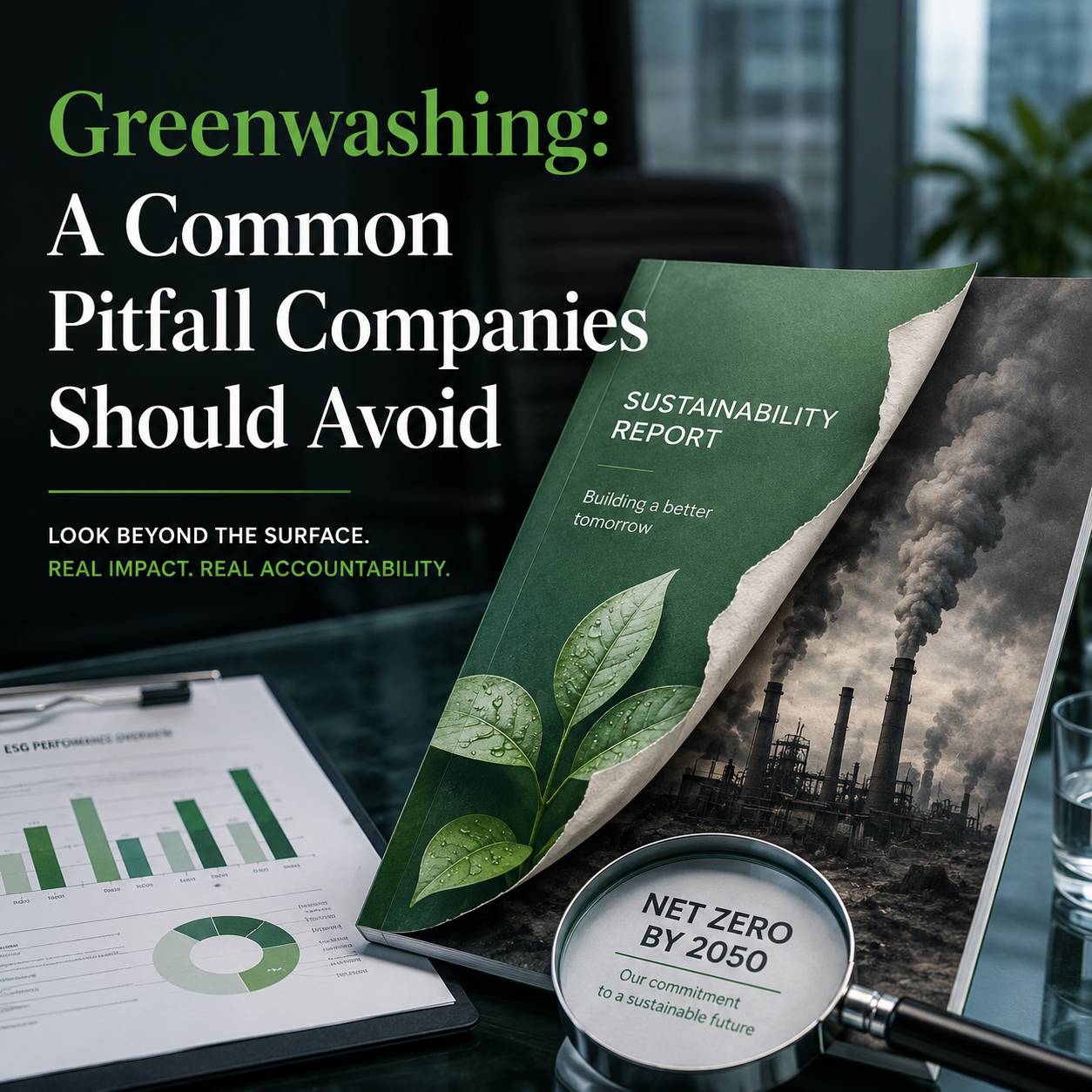
In the era gradually advocating sustainability, several terms such as “eco-friendly” and “recyclable” have been commonly appeared on product labels, relevant advertisement, and even ESG disclosures. However, are these terms reflecting the reality or just a deceptive description? This practice may cause companies to fall into grey areas of greenwashing if certain criteria is not properly met.
Definition of Greenwashing
Under ESG setting, greenwashing is an act from an organisation or company who intends to mislead the public by making misleading claims about their ESG performance. These claims can be presented in a way of ambiguous and exaggerated manner. In particular, a piece of research[1] defines greenwashing as a discrepancy between environmental communication and actual environmental practices, in which the practices are not as green as disclosed and the discrepancy arises from false, vague, irrelevant, or selective information.
Common Grey Areas with Potential Risks of Greenwashing
1) Buzzwords
In terms of ESG disclosures, companies tend to make use of various “marketing” keywords to demonstrate their ESG performance and achievement. In addition to the terms mentioned in the beginning of this article, “sustainable” and “carbon neutral” are some other commonly used wordings to showcase the positive environmental impacts generated. Unless companies clearly understand the meaning of these keywords and the applicability under their internal practical situations, improper use of these terms can lead to greenwashing.
2) Commitments / Targets
Companies may make commitments on ESG issues such as net zero, human rights, and accountability. However, there may not be any specific targets, action plans or measures established for achieving the commitment. With vague goals and objectives, it is difficult for companies to concretely contribute to their own commitments and tangible positive ESG performance, which may cause greenwashing at the end.
3) Bias
Some companies may only present or overemphasise their positive impacts and achievement while ignoring other material or negative impacts. To avoid bias and minimise the risk of greenwashing, companies should present both positive and negative impacts brought by its operations in a balanced manner so that the public can have a full picture of the companies’ ESG performance.
Potential Adverse Impacts of Greenwashing
When companies are identified or accused of greenwashing on ESG disclosures, legal and regulatory penalties may be arisen. Apart from trading suspension on stock exchanges, heavy fines and potential imprisonment for corporate directors and involved individuals can be resulted. This can significantly lower the reputation and credibility of companies, directly affecting the confidence and willingness of potential investors to invest in the company.
GreenCo’s Reminders: Establish and Implement Good Practices
Under the trend of enhancing ESG transparency, more ESG information will be disclosed while the risk of non-compliance and misinformation will also arise. To avoid falling into the pitfall of greenwashing, it is suggested to:
- Carefully apply wordings, commitments, and targets in ESG disclosures based on practical circumstances of companies while avoiding cherry-picking and partial disclosures;
- Document traceable ESG hard data and conduct audit whenever possible;
- Set measurable targets and action plans when establishing commitments; and
- Consult ESG advisory for ESG performance improvement and compliance check when necessary.
At GreenCo, multi-disciplinary professionals are available to offer help on impartially disclosing your ESG performance. We provide clients with a variety of services on the aspects of GHG accounting and calculation, ESG target setting, as well as ESG data collection platform building, and assurance. Contact us today to explore our services to drive your journey towards sustainability!
[1] Koch, T., & Denner, N. (2025). What is Greenwashing – A Scoping Review of Greenwashing Definitions and Development of the Need-for-Balance Model. Journal of Sustainable Business, 10(17), 1-13. https://doi.org/10.1186/s40991-025-00124-3
About GreenCo ESG Consulting
GreenCo is a professional ESG advisory firm accredited with ISO 9001 in the Provision of ESG / Sustainability Reporting, Sustainanbility and Climate Disclosures and GHG Accounting Advisory Services. Established in 2016, we were born to tackle ESG and climate risk management challenges. GreenCo has a professional team consists of talents with multiple backgrounds with
- PhD
- Practitioner Member of the Institute of Sustainability and Environmental Professionals (ISEP)
- CFA (the CFA Institute) and Certificate in ESG Investing
- EFFAS Certified ESG Analyst (CESGA)
- GRI Certified Sustainability Professional
- Certified Public Accountant (for assurance in accordance with ISAE 3000)
- Member of Global Association of Risk Professionals
- Master’s degree in envirnomental science
GreenCo has solid track record in ESG advisory for over 80 listed companies in Hong Kong, Mainland China, Singapore and Korea, covering all industries under the Hang Seng Industry Classification System.